Plumbing
Plumbing Financing for Contractors: The 2026 Guide
By Trevor Hansen· October 6, 2026· 5 min read

Plumbing work rarely waits for a good time. A water heater fails on a Sunday, a slab leak shows up under the kitchen, a sewer line backs up the week before a holiday. Customers need the work done and often have not budgeted for it. This guide covers how contractors use plumbing financing to close those jobs, what the 2026 data shows, which programs to know, and how to choose a provider.
Why plumbing financing for contractors matters in 2026
Three trends put more pressure on plumbing tickets this year.
Materials cost more. A 50% Section 232 tariff on the copper content of semi-finished copper products took effect on August 1, 2025. It covers pipes, tubes, wire and fittings, as summarized by White & Case. Copper-heavy jobs feel it most.
Water damage is expensive. State Farm paid more than $628 million on over 20,000 frozen pipe and water damage claims from January 2024 through June 2025. The average claim topped $30,000, according to its January 2026 release. Homeowners who have seen those numbers take leaks seriously. They also get sticker shock on repipes.
Customers have little cushion. The Federal Reserve's 2025 SHED report found only 63% of adults could cover a $400 surprise with cash. A $3,000 water heater or a $12,000 repipe is a different problem.
$30,000+
average State Farm payment on frozen pipe and water damage claims, Jan 2024 to Jun 2025
Plumbing has the biggest financing lift of any trade
ServiceTitan's analysis of H2 2025 jobs found financed plumbing jobs had a median ticket 75% higher than comparable jobs the customer chose not to finance. That was the largest lift among the trades it measured, ahead of HVAC and electrical at 66%. ServiceTitan notes the link is correlational, not causal.
The reason makes sense in the field. Plumbing customers often choose between a fix and a fix-it-right. Patch the leak or repipe. Swap in the same tank or upgrade. Clear the line or replace it. With a monthly option on the table, more customers choose the lasting solution.
Where plumbing jobs stall without financing
- Water heater replacements. Urgent, and often more expensive than the customer's memory of the last one.
- Sewer and drain line work. Camera findings turn a drain call into a line replacement.
- Repipes and slab leaks. Large, disruptive, and easy to put off.
- Emergency repairs. No time to shop, and no time to save.
- Fixture and remodel packages. Bathrooms and kitchens where plumbing is part of a bigger ticket.
Each of these is a moment where the customer needs an answer quickly. Financing turns a large number into a monthly option they can decide on right away. Without it, the customer's default is to delay, patch, or call around for a lower price, and every one of those paths ends with someone else doing the job.
The program types plumbers should know
| Program type | Best for | Watch out for |
|---|---|---|
| True 0% APR promotional | Customers who want to protect savings | Usually the highest merchant fee |
| Same-as-cash (deferred interest) | Customers who will pay off within the promo | Retroactive interest if they do not |
| Standard installment | Repipes and sewer lines where the monthly number matters | Longer terms mean more total interest |
| Extended credit spectrum | Fair and thin-file credit | Pricing varies more by applicant |
| Lease-to-own | Water heater customers without a credit option | Not in every state; costs more over time |
For the difference between the first two, read same-as-cash plumbing financing.
The biggest leak: declines on urgent jobs
Emergency work has no room for a slow or single "no." The New York Fed's Credit Access Survey put the rejection rate for credit applicants at 16.1% in June 2026. A customer with a failed water heater who is declined by your one lender does not wait. They call the next plumber, or they buy the cheapest tank at a big-box store.
A multi-lender waterfall runs the same application through more than one lender, so more customers get a usable answer during the visit. See plumbing financing for bad credit for how that works.
Water heaters: the everyday financing moment
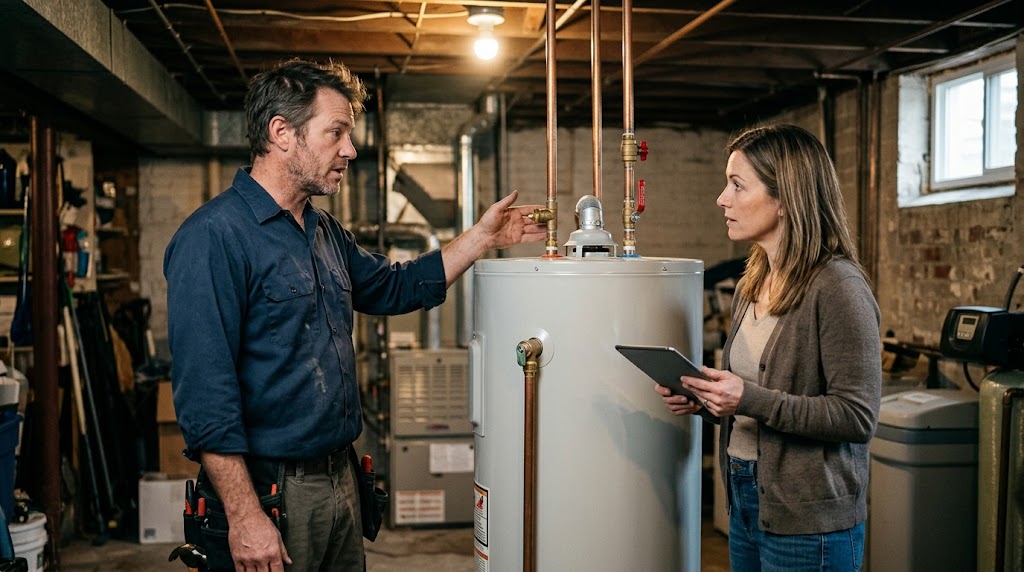
Water heater replacements are the most common place plumbing financing earns its keep. They are urgent, since nobody wants a week of cold showers, and the ticket has climbed with equipment and material costs. They also come with real choices: the same tank, a larger tank, a tankless unit, or a heat pump water heater.
Customers who pay cash usually pick the cheapest option that restores hot water. Customers comparing monthly options are more willing to consider the longer-lasting or more efficient unit. One change for 2026: the federal Section 25C credit covered qualifying heat pump water heaters. It ended for equipment placed in service after 2025, per Honkamp's summary of the One Big Beautiful Bill Act. Some utilities and states still offer rebates, so check your area.
When a water heater customer cannot get traditional credit, lease-to-own can be the last line of coverage where your provider and state allow it. Our post on water heater lease-to-own explains when it fits and how to present it honestly.
How to set up a plumbing financing program
- Offer it on every quote over a set amount, in writing, with a monthly option.
- Cover every credit tier behind one application.
- Match funding to same-day work. Most plumbing jobs finish in a visit or two.
- Know your costs and build them into your price book. See the cost of offering financing in plumbing.
- Train techs to present it without flinching. Our plumbing financing sales script has the words.
- Track declines by tech and job type.
Emergency calls need their own approach
Emergencies close on speed and trust. The best plumbers build financing into the emergency process. The CSR mentions monthly options when booking. The tech presents them with the repair-or-replace choice. The customer applies during the visit, together with the tech or by QR code on their own phone. Our guide to emergency plumbing repair financing walks through it.
How to choose between plumbing financing providers
Ask each provider five questions. How many lenders see one application? Are promotional offers true 0% or same-as-cash? What does each program cost you, in writing? How fast are you funded after a same-day job? Can your team see every application in one place?
Also ask whether it covers water heater lease-to-own where your state allows it, and how that option appears in the same application. That is often the last line of coverage for a customer with no hot water and no credit option. The full comparison is in best plumbing financing programs.
Frequently asked questions
Should plumbers offer financing on repairs or only replacements?
Both. Large repairs, water heaters, sewer lines and repipes can all carry tickets customers did not plan for. Offer a monthly option wherever the ticket is large enough to stall the decision.
Can water heaters be financed with lease-to-own?
Lease-to-own is available for water heater replacements through some providers and not in every state. It is best kept as the last option after loan programs.
What does plumbing financing cost the contractor?
It depends on the program. Promotional offers such as 0% APR or same-as-cash usually carry the highest merchant fees. Standard installment programs usually cost less.
How do I choose a plumbing financing provider?
Compare coverage across credit tiers, what happens after a decline, how quickly you are funded on same-day work, which program types are offered, and the cost of each in writing.
Sources
- ServiceTitan, Financing in the Trades (2026)
- State Farm, Frozen pipes: beat winter water woes (2026-01-20)
- White & Case, 50% Section 232 tariff on copper imports (2025)
- Federal Reserve, SHED 2025 (2026-05-13)
- New York Fed, SCE Credit Access Survey (2026-07-20)
- Honkamp, Impact of the One Big Beautiful Bill Act on residential energy credits (2025)