Roofing
Roof Financing for Bad Credit Customers: How Roofers Keep the Job
By Trevor Hansen· October 11, 2026· 5 min read
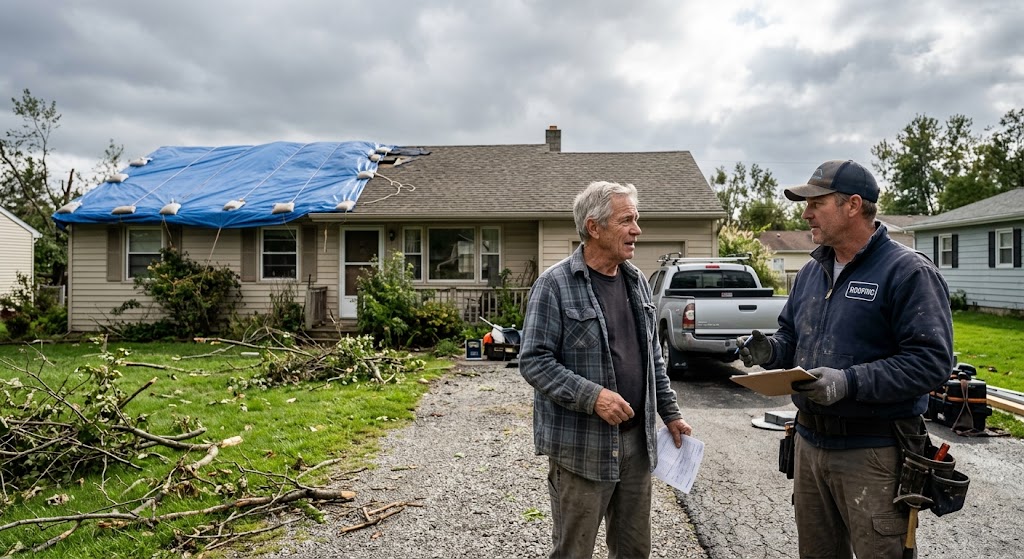
Hail does not check anyone's credit score before it hits a roof. After a storm, roofers meet every kind of household: homeowners with perfect credit, and homeowners who have been declined for a store card. Both need a roof. This guide covers roof financing for bad credit customers, why declines are rising, and how contractors keep the job when the first answer is no. For the basics, see our roofing financing page.
Why roof financing for bad credit customers matters now
Storms keep coming. Severe convective storms caused $51 billion in U.S. insured losses in 2025, the third straight year above $50 billion, according to Triple-I data reported by Digital Insurance. Hail accounts for about 80% of those claims.
At the same time, credit is not easy to get:
- The New York Fed's Credit Access Survey put the rejection rate for credit applicants at 16.1% in June 2026.
- The Federal Reserve's July 2026 loan officer survey found a modest net share of banks tightening credit card standards.
- The New York Fed's Q2 2026 household debt report found 6.97% of credit card balances flowing into serious delinquency.
$51B
U.S. insured losses from severe convective storms in 2025, mostly hail
Put simply: more roofs need replacing, and a real share of the homeowners who need them will hear no from at least one lender.
Where declines hurt roofers most
On a retail roof, a decline usually means the homeowner waits and patches. On an insurance job, a decline on the homeowner's share can stall the whole claim.
That share keeps growing. Matic's 2025 report found average deductibles rose 24.5% in a year, and wind and hail deductibles of 1% to 5% of the insured value are spreading. On a $350,000 home, a 2% deductible is $7,000. Add depreciation on an older roof and the homeowner may owe more than they have ever financed before.
If your only lender declines that homeowner, you are left with a signed adjuster report and no job.
Why single-lender programs decline homeowners who would qualify elsewhere
Every lender draws its own credit box. Homeowners inside it get approved. Homeowners outside it are declined, even when another lender would say yes that same afternoon.
A single-lender program makes that one box your whole customer base. It is not a verdict on the homeowner. It is a limit of the program.
The credit spectrum for roofing
| Homeowner | What they need | Program type that fits |
|---|---|---|
| Prime | Cover the deductible or upgrades without touching savings | True 0% APR, short promo |
| Near-prime | A reasonable monthly payment | Standard installment |
| Subprime or thin file | A yes on the homeowner's share or a basic roof | Extended credit spectrum lenders |
| Large retail roof, any tier | The lowest monthly number | Extended-term installment |
Lease-to-own is generally not available for roofing, so the lower tiers depend on loan programs that cover them. Make sure yours does.
How second-look financing keeps the roof sold
Second-look financing sends a declined application to another lender. The cleanest version is automatic: the homeowner applies once, and the application moves down a waterfall of lenders until one fits. No second form, no second portal, no awkward pause on the porch.
Smaller amounts help too. A homeowner declined for a full retail roof may qualify for the deductible alone. If the claim covers the rest, that can be the difference between a closed job and a tarp through the winter.
What to say when a homeowner is declined
The words matter as much as the lender. Train every rep on three moves.
- Stay neutral. "The application checks several lenders automatically. Here's what came back for you." No apology, no guesses about credit.
- Let the waterfall do the work. There is no second form and nothing for the rep to resubmit. The same application has already checked the other lenders.
- Protect the homeowner's dignity. Keep your voice down. Let them read the result on their own phone or yours, not over a spouse's shoulder. Never say "bad credit."
If the approval comes back smaller than the full job, say so plainly: "Here's what you're approved for. Let's look at an option that fits it." Then go back to the estimate. A standard material option, or financing only the homeowner's share, is still a signed roof. If nothing comes back, thank them, leave the written estimate and keep the door open. For the full script, see the roofing sales financing pitch.
Set the conversation up before anyone applies
Declines sting less when the homeowner already knows there are several paths.
- Normalize options early. When you present the estimate, mention that you work with more than one lender and that many homeowners compare monthly options.
- Start the application while you are there. Apply together on your device, or let the homeowner scan a QR code and apply privately on their own phone. A homeowner who puts it off often never starts.
- Make it easy to apply later. If a spouse needs to weigh in, send a text or email invite before you leave. Put the web link on your website and every estimate too.
- Keep material tiers. A good, better, best estimate lets you fit the approval without losing the job.
- Never pre-judge. Reps who skip financing for homeowners who "look like" bad credit are wrong often enough to cost real roofs.
Retail roofs: when waiting is the real risk
On a retail job with no claim, a declined homeowner often decides to patch and wait. That feels safe, but an aging roof keeps aging. Leaks spread into decking and insulation, and a future storm claim on an old roof may pay less under actual cash value coverage.
You do not need to scare anyone. Lay out the options honestly: a repair now with its limits, or a replacement with a monthly option that fits the approval. Homeowners who feel informed rather than pushed are the ones who call you back when they are ready.
Stay clean on the deductible
A declined homeowner may ask you to "just take care of" the deductible. Do not. Waiving or rebating deductibles is illegal in several states, and it puts your license and your insurance relationships at risk. The honest options are financing the deductible, offering a lower-cost material tier, or waiting until the homeowner can pay. Our post on roof financing and insurance deductibles covers the rules.
Count your declines before you fix them
Most roofers do not track their decline rate. Start by rep and by job type. Then run the math: applications per month times decline rate gives declined homeowners. Multiply by your close rate and average ticket, and you have the revenue that stopped at the credit screen.
Say you see 30 applications a month and 25% are declined. That is 7 or 8 homeowners. If you would have closed half of them at a $14,000 average, that is roughly $52,000 a month. The What You're Missing calculator runs your own numbers.
The bottom line on roof financing for bad credit
Storm damage does not wait for better credit, and neither should your pipeline. Cover the full credit spectrum, put it behind one application, and train reps to handle a no without losing the porch. For a deeper look at longer terms for big retail roofs, read extended-term roof financing.
Frequently asked questions
Can homeowners with bad credit finance a new roof?
Often, though not always through the first lender. Programs exist across the credit spectrum, and a multi-lender application gives more homeowners a usable answer. Approval is never guaranteed.
Can I finance just the insurance deductible with bad credit?
Sometimes. A smaller amount can be easier to approve than a full roof. The deductible must still be paid in full by the homeowner.
What should a roofer say when financing is declined?
Keep it neutral. The one application checks several lenders automatically, so say: 'Here's what came back for you.' If the approval is smaller, offer a phase one that fits it. Never guess why or mention credit.
Is lease-to-own available for roofs?
Generally not. Roofing coverage for lower credit tiers comes from extended credit spectrum loan programs rather than leases.
Sources
- New York Fed, SCE Credit Access Survey (2026-07-20)
- New York Fed, Household Debt and Credit Report Q2 2026 (2026-08-11)
- Federal Reserve, Senior Loan Officer Opinion Survey, July 2026 (2026-08-03)
- Digital Insurance, Severe convective storms caused $51B in 2025 losses (Triple-I) (2026-04-27)
- Matic, 2025 Home Insurance Report (2025)